

In 2026, last-mile delivery challenges start before a driver ever sees the order. They start on the checkout page, where a clean little promise — same-day, narrow window, free return — silently hands the bill to the supply chain.
A VP of supply chain knows that this bill rarely lands in one place. It shows up as store labor stretched past the plan, second attempts that erase margin, customer care digging through vague tracking, inventory trapped in returns, and a finance team wondering why the delivery program looked so much better in the model than it does in the field.
That’s the 2026 version of last mile. The customer sees convenience. The operation absorbs the complexity. Speed still sells, but the harder work is building a delivery network that can keep the promise, catch exceptions early, protect the brand, and recover cleanly when the real world ignores the plan.
The five trends below show where the pressure is building now.
- Customers Want Reliable Delivery More Than Fast Delivery
The arms race is real.
Amazon’s three-hour delivery now hits more than 2,000 cities, and one-hour covers over 90,000 products in launch markets. FedEx rolled out SameDay Local with two-hour windows. So if you sell anything online, the pressure to promise faster never lets up.
But that pressure is mostly a trap.
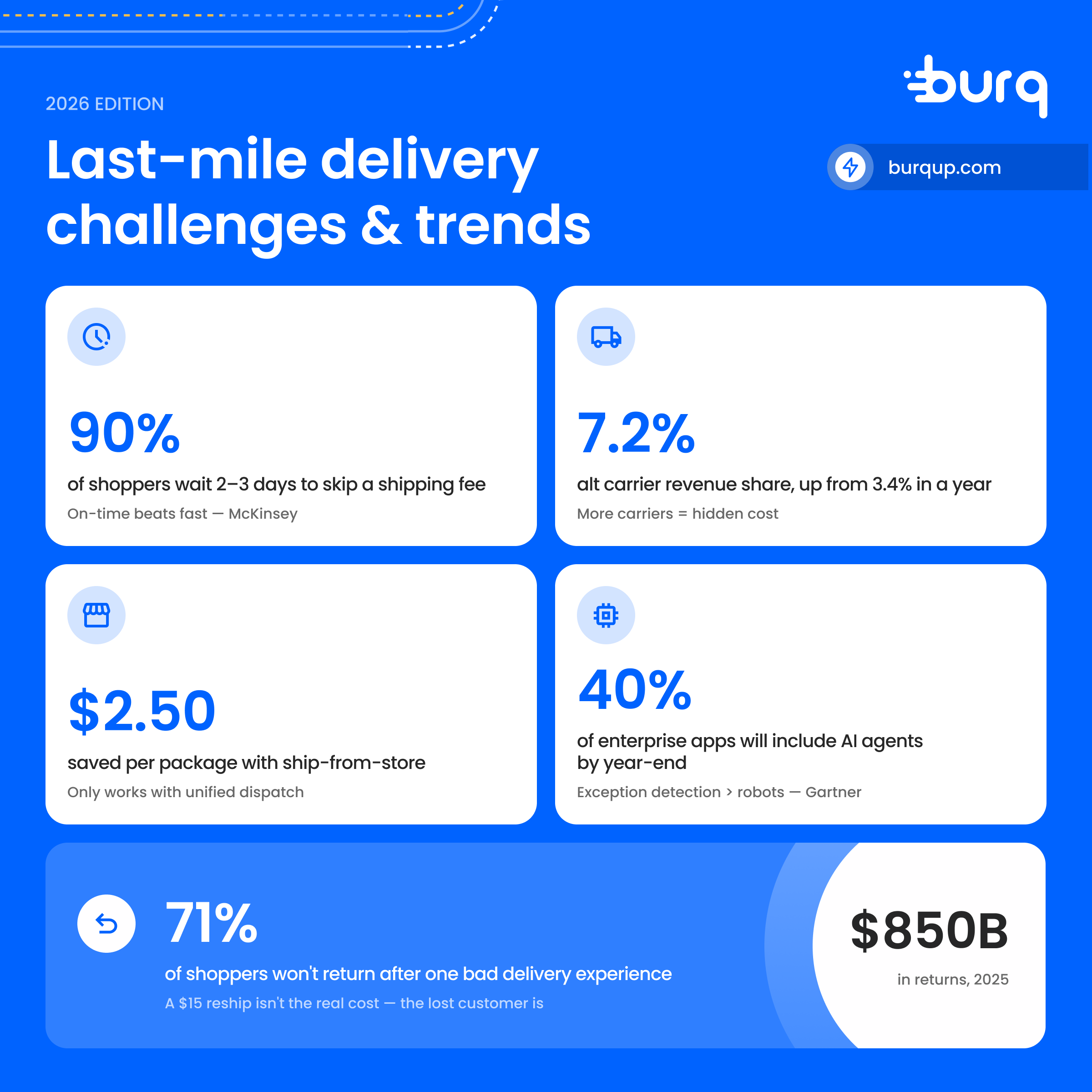
When McKinsey asked, 90% of shoppers said they’d wait two or three days to skip a shipping fee, more than 95% preferred free standard over paid express, and they ranked on-time delivery ahead of speed.
Nobody’s loyal to a retailer because a $14 order showed up in 90 minutes. They’re loyal because it showed up when you said it would. Spend your speed where the margin and the customer justify it. Everything else can ride the cheaper standard tier, and most customers won’t blink.
- Running More Carriers Usually Raises Your Costs
Coverage is the other thing retailers chase, and it comes with a hidden bill. The parcel market keeps splitting apart: volume hit 23.1 billion shipments in 2025, up 3.3%, and smaller alternative carriers doubled their share of revenue in a year, from 3.4% to 7.2%.
More options, the thinking goes, means better coverage and better rates.
Then the first of the month arrives, and you’re reconciling three carrier invoices, each with its own rates, cutoffs, surcharges, and idea of what counts as delivered.
Researchers who studied 6,112 Amazon routes called last-mile logistics about as complex as it gets. The cost rarely shows up as one big number, just a package on the wrong truck, a redelivery you ate, a support rep untangling a status by hand, a few thousand times a month.
Run your providers through one connection, and most of that overhead disappears.
- Shipping From Stores Cuts Cost and Adds Complexity
Store fulfillment is the rare idea that pays off, with a catch. Target is scaling its Last Mile Delivery Direct program from six stores in two markets last year to over 100 stores in 50 markets by the end of 2026, and pegs the savings at roughly $2.50 a package versus a national carrier. It’s a genuine cost win.
The catch is that everything that has to happen on the floor to earn it.
On a Saturday, the same associate is ringing up a walk-in and picking three online orders. Each one needs a routing call: store driver, courier, parcel carrier, or your own fleet. When a pick runs late, or the shelf’s empty, somebody has to catch it before the customer does.
That coordination is the whole ballgame, and it only holds when dispatch, carrier choice, and tracking run from one system instead of getting rebuilt aisle by aisle.
- AI’s Most Useful Job Is Catching Failures Early
Most of the AI noise in delivery is about robots and self-driving vans, which won’t touch most retailers’ numbers for years. The version that pays now is boring by comparison: it watches for failures.
No dispatcher can track a few hundred live orders against traffic, weather, and who’s actually free to drive, but software does it without blinking. NRF, citing Gartner, expects 40% of enterprise apps to include task-specific AI agents by year-end, and this is the job worth handing them.
The point is to catch the miss before the customer feels it. The order sliding past its window, the pickup that never happened, the proof-of-delivery photo of someone else’s porch, flagged and fixed while there’s still time. A 2026 study on agentic AI found that this coordination is still mostly manual and reactive across stores, warehouses, and suppliers, which is exactly the gap retailers are funding in 2026.
- A Failed Delivery Costs Far More Than The Redelivery
Now the expensive one.
Most teams log a failed delivery as the cost of reshipping it, then move on. That accounting is wrong. The real cost is the customer you just lost, not the second truck.
NRF estimated $850 billion in returns in 2025, about 19.3% of online orders, and 71% of shoppers say one bad return experience makes them less likely to come back. ACSI has online retail satisfaction stuck at 79.
Do the math on a single failure: a reship costs $15 dollars, but a customer who quietly leaves takes every order they’d have placed over the next few years with them.
That’s the bill, and it shows up nowhere on the delivery line. It’s worse for groceries and perishables, where a blown delivery also means spoiled product and wasted labor on top of the lost relationship. Build for returns and recovery, not just the first attempt.
Build a Last-Mile Operation That Can Keep Up With 2026
Retailers have spent years making delivery promises easier for customers to say yes to. Faster windows, more options, fewer fees, easier returns. That part worked. The harder part is what those promises create behind the scenes.
A delivery promise now pulls on store teams, inventory, customer care, dispatch, returns, refunds, and margin. When all of that runs through scattered carriers and manual workarounds, the breakdowns don’t stay small. A missed handoff becomes a support issue. A bad ETA becomes a brand issue. A second attempt becomes a margin issue. A messy return gives the customer a reason to think twice next time.
Burq gives retailers one place to run the full delivery operation: on-demand, same-day, and scheduled delivery move through one platform across hundreds of providers and your own drivers. Tracking, vehicle options, returns, and recovery are built into the flow. Pulse AI helps choose the right provider before dispatch, then keeps watching each order in motion so at-risk deliveries can be rerouted before they fail.
Think fewer support tickets, fewer refunds, fewer missed promises, and less time spent chasing carrier issues. Instead of reacting to delivery problems after customers notice them, teams can prevent many of them before they escalate.
Schedule a demo to see how Burq helps retailers run the last mile with more control, better visibility, and fewer delivery failures.