

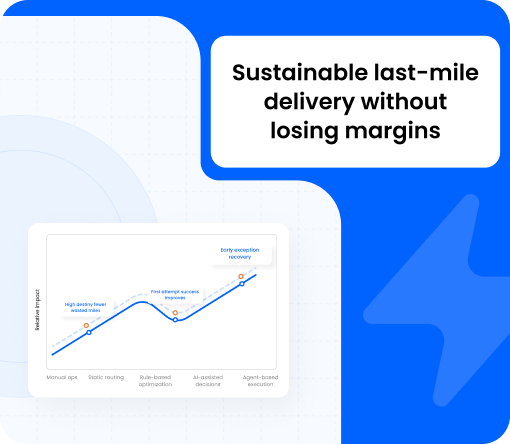
Sustainability in last-mile delivery often gets treated like a separate program, something layered on after speed and cost are “handled.” In real operations, it’s rarely additive. The most reliable path to a greener last mile is usually the same path to stronger unit economics: remove waste.
Waste is what happens when delivery plans don’t survive contact with reality. A route that looks efficient at 8 a.m. becomes inefficient by noon because of cancellations, stalled pickups, access issues, inaccurate ETAs, or failed first attempts. Every one of those outcomes creates extra miles, extra labor, extra support work, and extra customer friction. That’s a carbon problem and a margin problem at the same time.
In the U.S., this conversation is accelerating for a simple reason: customers and procurement teams increasingly want defensible emissions data across the supply chain, especially Scope 3, without accepting higher costs as the tradeoff. State-level momentum is adding to that pressure (California’s climate disclosure laws are one of the clearest signals), while national requirements and timelines continue to evolve.
Even for U.S.-based teams that aren’t directly reporting today, expectations can still show up indirectly through enterprise RFPs, supplier scorecards, and “prove it” questions about delivery efficiency and repeat attempts. And globally, frameworks like the EU’s CSRD reinforce the same direction for multinational buyers: more rigorous value-chain reporting and more scrutiny on logistics emissions.
All of this converges into a single, practical question:
How do last-mile teams make operations more sustainable without turning sustainability into a margin tax?
A useful answer starts with a reframing: sustainability isn’t a separate goal. It’s an operational outcome that falls out of running fewer wasted miles, fewer repeated attempts, and fewer exceptions. The next step is making those outcomes reliable day-to-day, which is where AI and agent-based execution becomes relevant.
Why “sustainable vs. profitable” is a false tradeoff
Last-mile delivery is unusually vulnerable to compounding inefficiency. It’s fragmented, time-bound, customer-facing, and full of edge cases. One small miss early in the day can ripple into missed windows, reattempts, refunds, escalations, and support tickets.
Failed first attempts are a clear example of how quickly waste multiplies. Research published by Harvard Business Review cites that up to 20% of e-commerce packages aren’t delivered on the first attempt. A failed attempt doesn’t just inconvenience the customer, it forces the system to do the work twice.
That’s why the most productive sustainability efforts in last mile don’t start with a “green checklist.” They start with eliminating the operational loops that should never have happened in the first place.
The Margin-Safe Sustainability framework
There are many sustainability tactics in delivery, such as electrification, cargo bikes, lockers, and packaging changes. Some are excellent. But the operational levers that consistently protect both margin and emissions show up in almost every delivery model:
- Increase delivery density (more stops per mile)
- Raise first-attempt success (avoid re-delivery loops)
- Choose the right execution path per order (stop defaulting)
- Reduce exception cost (recover early, before it snowballs)
These levers are also the places where AI is most likely to create real outcomes, because they’re decision-heavy and time-sensitive.
1. Increase delivery density (more stops per mile)
Density is the quiet hero of both cost and carbon. More stops per mile generally means less energy per order and less labor per order.
The catch is that density is fragile. It depends on time windows, capacity, geography, order release timing, and the service promises customers see at checkout. Static route plans break easily when conditions change, which leads to inefficient resequencing, last-minute reassignments, or rushed decision-making.
Operationally, the shift is moving from “one perfect route plan” to continuous optimization:
- keep batching opportunities open as new orders drop
- rebalance when a stop is at risk of slipping a window
- avoid leaving capacity stranded when cancellations hit
This is where agent-style execution matters: the system can keep re-optimizing as the day evolves, rather than waiting for humans to notice a problem.
2. Raise first-attempt success (kill re-delivery loops)
If density is the upside lever, first-attempt success is the waste-elimination lever.
A failed delivery isn’t “just one more stop.” It’s a second trip, additional customer communication, and often more internal work to reschedule. Multiply that across even a modest failure rate, and the margin impact becomes structural.
Most failed attempts aren’t caused by the driver’s ability to complete the delivery. They’re caused by avoidable conditions:
- the customer isn’t available when a signature is required
- access instructions are missing or unclear (gates, call boxes, business hours)
- contact methods aren’t confirmed
- the promised window doesn’t match the receiving reality
What improves first-attempt success is earlier intervention, while the operation can still change the outcome. That can look like tightening ETA windows, prompting for access details, confirming availability for signature deliveries, or shifting the stop timing before it becomes a failure.
3. Choose the right execution path per order (cost + carbon-aware decisioning)
Many teams don’t choose how orders are delivered, they default. Defaulting is expensive because it ignores context.
Order-level decisioning is the practice of selecting the best delivery option based on the specifics of the order and the realities of the network:
- distance and geography
- SLA tier and time window strictness
- order value and risk tolerance
- Perishability / temperature needs
- signature / ID checks
- provider performance by zone and time-of-day
Diversified delivery networks create opportunity here; multiple options can reduce cost and improve reliability. But they also create complexity that’s hard to manage manually at scale. Without decisioning, networks can devolve into habit: the same provider, the same service level, the same approach, even when it’s not the right fit.
AI becomes useful when it consistently evaluates tradeoffs in real time, inside guardrails like max cost thresholds, minimum reliability standards, and compliance requirements, so the operation stops paying the “default tax.”
4. Reduce exception cost (automate recovery before it snowballs)
Exception handling is where many last-mile margins quietly disappear. By the time a late pickup becomes a missed window, the system has fewer good options left and recovery gets expensive: expedite, reroute, refund, reattempt.
The goal isn’t speed for its own sake. It’s speed of decisioning, catching risk while cheaper recovery options still exist.
This is where agents are at their best: monitoring real-time signals (ETA drift, stalled movement, delayed pickup events, provider anomalies) and triggering recovery actions early, before the day turns into a cascade of make-goods.
Where AI and agents actually help (and where they don’t)
A lot of “AI in logistics” content stops at visibility within dashboards, reports, and predicted ETAs. Visibility helps, but it doesn’t guarantee outcomes. What changes outcomes is execution.
That’s why agent-based models are gaining traction: they bridge the gap between detection and action. Instead of simply flagging a risk, agents can recommend or execute the next best step within defined policies.
It’s also where the climate opportunity is most concrete. The World Economic Forum has published analysis suggesting that, with AI support, the freight logistics sector could potentially reduce emissions by 10–15%, while also improving efficiency and service levels.
A simple way to think about agentic execution in last mile:
Signals → Detection → Decision → Action → Learning
Below is a practical mapping of the four levers to operational outcomes and agent behavior.
.png)
Metrics that prove “sustainable and profitable”
Sustainability efforts stall when they can’t be tied to operational reality. The best metrics are the ones that operations and finance both recognize and that can be used to show progress without needing perfect carbon accounting on day one.
A strong starting set:
Margin metrics
- cost per order (and cost per stop for multi-stop routes)
- exception rate and cost per exception
- first-attempt success rate
- refunds/credits tied to delivery issues
Sustainability proxies
- miles per stop (or miles per order)
- reattempt rate and reattempt miles
- idle time per route
- % of orders routed to lower-emission modes where available
These measures also make value-chain reporting conversations easier. Even if requirements differ by region, procurement teams increasingly ask for defensible data across the supply chain. CSRD timelines and standards like ESRS E1 reinforce that direction by formally anchoring emissions disclosure across scopes.
A practical implementation playbook that won’t add manual work
The most common failure mode in AI initiatives is treating them like a tool rollout. Last-mile teams rarely need more software. They need a system that changes outcomes when reality changes.
A pragmatic approach starts with three components: signals, guardrails, and a narrow first wave of automations.
Signals: the minimum data needed to make better decisions reliably (order attributes, location quality flags, provider performance by zone/time, tracking events, ETA drift indicators). This doesn’t need to be perfect, just consistent.
Guardrails: the policies that keep decisions aligned with business priorities (max cost thresholds, SLA tiers, compliance rules for signatures/ID checks, customer communication rules, escalation triggers). Guardrails are what prevent “AI” from becoming unpredictable.
First wave of automations: choose outcomes that are measurable and frequent enough to matter. A common starting point is any combination of:
- continuous batching and route re-optimization as conditions shift
- proactive prevention of the most common failed-delivery causes
- early recovery when pickup stalls or ETA drift crosses a threshold
The goal isn’t to automate everything. It’s to prove the system can reduce wasted miles and exception cost while maintaining service levels.
Common pitfalls that make sustainability feel expensive
Sustainability becomes a margin tax when it’s treated as reporting instead of operations.
When it lives in quarterly reports, it can’t change daily outcomes.
If metrics don’t connect to actions, they become retrospective scorekeeping.
When it optimizes for speed only, it creates repeat work.
Speed helps when it reduces idle time and prevents failures. It hurts when it increases exceptions and failed first attempts.
When it relies on static rules, it breaks in a dynamic world.
Last mile is variable by nature: traffic, staffing, weather, demand spikes, customer availability. Rigid automation tends to fail at the edges, exactly where the cost is hiding.
When exception handling is underestimated, the margin leakage continues.
Exceptions are where cost and emissions compound. Earlier detection and faster recovery often produce more impact than a “perfect route” ever will.
Sustainability that scales is operational
The most sustainable last-mile operation is usually the one that wastes the least: fewer unnecessary miles, fewer reattempts, fewer exceptions, and fewer manual interventions. That’s how sustainability stops being a program and becomes a property of the system.
AI and agents matter when they do one thing well: turn real-time delivery signals into real-time decisions and actions so density holds, first-attempt success improves, and exceptions are resolved before they become expensive.
For teams exploring this model, a simple north star works: build an intelligence layer that can detect risk early, decide within guardrails, and execute with agents across dispatch, communication, and recovery. That’s how sustainability improves without blowing margins.