

Right now, a delivery driver is standing in an apartment lobby with a treadmill that won’t go up the stairs. He’s got a decision to make. He could call it in. Or he could try to muscle it up.
He does neither. Instead, he photographs the box in the lobby, taps “attempted” like that’s a real outcome, and heads to his next stop.
Up on the third floor, a customer who blocked off her whole afternoon for this watches a treadmill she paid for drive away in a van. She gets an apology email and a refund. The store gets a one-star review and a customer who’s done with them. Everybody loses, and nobody planned for it.
This is what big and bulky delivery does to a company that’s great at shipping small stuff. The whole setup that moves a thousand phone cases a day, the delivery providers, the software, the routing, stops working the second someone buys a sectional.
None of it was built to put a couch in a living room, yet most retailers are still using it anyway.
Big & Bulky Delivery Breaks the Parcel Playbook
Small-parcel delivery is a beautiful, predictable machine. Pack a van, run a hundred stops, 90 seconds a door. It works because every box is basically the same, and the driver never sets foot inside anyone’s home.
Something like a refrigerator is the opposite kind of job. That one stop takes an hour. You need two people, a truck with a lift gate, a route planned around the loading dock, and a bunch of details a ZIP code can’t tell you: how wide the stairwell is, whether the elevator works, and whether anyone’s home.
Running this on autopilot doesn’t work. Every order has to go to the truck and crew that can pull it off, and the cheapest carrier, plus a prayer, is not getting a couch to the third floor.
There’s more of this every year too. Online retail did $326.7 billion last quarter, and much of it was thanks to big and bulky deliveries that would never fit in a van: furniture, appliances, the works.
The Delivery Window Becomes the Customer Promise
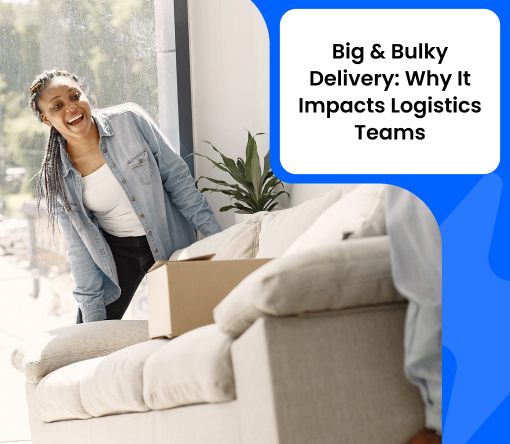
With a big and bulky delivery item, the delivery window is everything, because your customer has rearranged their entire day around it. They cleared the room, hauled the old couch to the curb, took time off work, and now they’re parked by the front window waiting on the two-hour slot you gave them.
Customers care about this optionality more than speed. McKinsey found that they rank showing up on time ahead of showing up fast. More than half want to pick a window, and around 7-in-10 city shoppers want to choose the slot themselves.
The window is fragile too, and one mistake takes the rest of the day with it. Blow the morning slot and the whole afternoon dominoes, because a two-hour appointment you can’t move on the fly drags every stop behind it down too.
Store Teams Get Pulled Into Logistics They Weren’t Built to Run
When the delivery side can’t cope, it all lands on the store. Your salespeople are suddenly running a tiny, miserable logistics operation out of the back room: stacking giant boxes, taking angry “where’s my couch?” calls, arguing damage claims, and rebooking every delivery that went wrong.
It’s also grueling, physical work, and people get hurt doing it. Hauling heavy, off-balance goods, in fact, is some of the most dangerous work in the country. Warehousing and transportation post the highest injury rate of any major industry, with overexertion, the back-and-shoulder kind, behind roughly 44% of last-mile injuries.
On the books, it reads as labor costs creeping up and an on-time number that keeps sliding for no reason anyone can name. Until one of those misses graduates into a return.
Returns and Exceptions Hit Harder Because the Item Is Harder to Recover
Sending a couch back is a much bigger job than sending back a shirt. The shirt goes in a prepaid bag and disappears. The couch becomes a whole project: a new appointment, two people, a truck, then someone to unwrap it, inspect it, wedge it back into the warehouse, and decide whether it’s still sellable or now just clutter.
The numbers here are enormous. Shoppers returned $849.9 billion worth of merchandise in 2025, close to a fifth of everything bought online. On a big item, every one of those returns shows up with a crew and a truck in tow.
The handling is annoying, sure. The customer is the part that really costs you. She took a half day off, got a photo of a treadmill where her treadmill should be, and she is never buying from you again. Seven-in-10 people don’t come back after one bad return, which means stopping the delivery from failing in the first place is worth far more than any cleanup.
Retailers Need Capability Coverage, Not Just Provider Coverage
Most retailers reach for one of two fixes, and both are wrong.
First, they sign another provider and feel productive watching the coverage map turn green. Trouble is, “covers your ZIP” and “can deliver a sofa” are two different claims: that carrier might own zero lift-gate trucks, can’t field two people, skips Saturdays, and won’t come back to fight your stairs twice.
Second, they build the whole thing themselves. Home Depot did that, with its own delivery hubs for appliances and flatbed yards for lumber, and at its scale, it makes sense. But you are not Home Depot. At a few thousand big and bulky orders a month, a DIY network mostly means a warehouse lease and a fleet of trucks you bought to watch sit there.
Big and bulky demand is also all over the place. Furniture rose 3.35% this May, while building supplies dropped 1.88%, costs climbing throughout. Owning a fixed fleet for swings like that just pays for empty trucks. It’s cheaper to rent capacity by the order, flex it as the volume moves, and run the whole operation through one platform built for scale. That’s the version that survives a bad quarter.
Big & Bulky Delivery Needs a Network Built for the Real World
Big and bulky delivery is where a brand earns a repeat customer or loses one for good. The order is large, the window is fixed, the customer is right there, and there are no second chances. Getting it right takes more than another provider or a fleet of your own.
Burq gives you that without the overhead. One platform connects you to hundreds of delivery providers and your own drivers, matches each order to the right vehicle, crew, and window, and handles returns on the same system. You scale capacity up when demand spikes and back down when it drops, instead of paying for idle trucks.
Pulse AI handles the exceptions underneath all of it, watching every order in real time, rerouting the ones headed for trouble before they fail, and picking the best provider for each delivery. That’s how we hold a 99%+ success rate while keeping failed deliveries, refunds, and support calls down.
Big bulky orders are only becoming a larger share of retail. Schedule a demo to see how we handle them at scale.